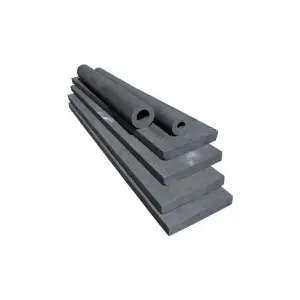
Graphite Plate is a rigid graphite material widely used in high-temperature processing, metallurgy, chemical equipment, furnace systems, electrical applications, mold manufacturing, and mechanical sealing. Compared with graphite powder, graphite plate is a shaped graphite product with fixed dimensions, stable structure, and stronger mechanical usability, making it suitable for equipment components, support plates, insulation parts, conductive plates, and wear-resistant elements.
Because graphite has excellent heat resistance, thermal conductivity, electrical conductivity, chemical stability, and self-lubricating properties, Graphite Plate can perform well in harsh working environments where metal, plastic, or ceramic materials may face limitations. For industries that require stable performance under heat, corrosion, friction, or electrical load, graphite plate is often selected as a practical functional material.
Understanding Graphite Plate
Graphite Plate is usually made from high-quality graphite raw materials through molding, baking, impregnation, graphitization, machining, and surface treatment processes. According to different applications, it can be produced in various sizes, thicknesses, densities, and purity grades.
Unlike loose graphite powder, graphite plate has a solid structure and can be cut, drilled, milled, polished, or customized into different shapes. This gives it stronger application value in industrial equipment and precision components.
Common types of Graphite Plate include:
- Molded graphite plate for general industrial use.
- Isostatic graphite plate for high-precision and high-strength applications.
- High-purity graphite plate for semiconductor, photovoltaic, and electronic industries.
- Impregnated graphite plate for improved density and corrosion resistance.
- Flexible or composite graphite plate for sealing and thermal management applications.
The right type should be selected according to working temperature, mechanical load, chemical environment, size tolerance, and service life requirements.
Key Properties of Graphite Plate
Graphite Plate is widely used because it offers a combination of properties that are difficult to achieve with many conventional materials. It can maintain stable performance in demanding industrial conditions.
Main properties include:
- High temperature resistance: Graphite can remain stable in many high-temperature environments.
- Good thermal conductivity: It helps transfer heat efficiently and evenly.
- Electrical conductivity: It can be used in conductive fixtures, electrodes, and electrical components.
- Chemical corrosion resistance: It resists many acids, alkalis, and chemical media.
- Self-lubricating performance: It helps reduce friction in sliding or contact applications.
- Low thermal expansion: It supports dimensional stability during heating and cooling.
- Easy machining: It can be processed into customized plates, blocks, grooves, and shaped parts.
These characteristics make Graphite Plate suitable for applications where heat, electricity, corrosion, and mechanical wear need to be considered together.
Graphite Plate in Furnace and Heat Treatment Equipment
One of the most important uses of Graphite Plate is in furnace and heat treatment systems. In high-temperature furnaces, graphite plates may be used as support plates, insulation parts, heating components, trays, liners, and structural elements.
In these applications, Graphite Plate provides several advantages:
- It can withstand high operating temperatures.
- It helps maintain stable thermal performance.
- It has good resistance to thermal shock.
- It can be machined into precise sizes for furnace structures.
- It supports repeated heating and cooling cycles when properly selected.
Industries such as metallurgy, ceramics, hard alloy processing, powder metallurgy, and vacuum furnace manufacturing often use graphite plate because it can remain reliable under demanding thermal conditions.
Graphite Plate for Chemical and Corrosion-Resistant Equipment
Graphite Plate is also valued in chemical processing because of its corrosion resistance. In many chemical environments, some metals may corrode quickly, while graphite can maintain better stability against certain acids and corrosive media.
Typical chemical-related applications include:
- Heat exchanger parts.
- Corrosion-resistant linings.
- Chemical tank components.
- Electrochemical equipment.
- Acid-resistant processing parts.
- Sealing and separation plates.
For chemical equipment, material purity, density, porosity, and impregnation treatment can strongly affect performance. Impregnated graphite plate is often used when better sealing performance, improved strength, or lower permeability is required.
Graphite Plate in Electrical and Conductive Applications
Due to its electrical conductivity, Graphite Plate is used in many electrical and electrochemical applications. It can serve as a conductive plate, electrode material, battery-related component, or current-carrying fixture.
Common uses include:
- Electrolysis plates.
- Conductive fixtures.
- Battery test components.
- Electrical discharge machining materials.
- Carbon brush and contact-related parts.
- Electrochemical reaction equipment.
In these applications, electrical resistance, purity, density, and machining accuracy are important selection factors. High-purity graphite plate may be required when contamination control is important.
Mold Manufacturing and Mechanical Components
Graphite Plate is also used in mold manufacturing and mechanical applications. Because graphite has good machinability, thermal stability, and self-lubricating performance, it can be processed into molds, guide plates, wear plates, and sliding parts.
In mold-related applications, Graphite Plate can help:
- Improve heat distribution.
- Reduce friction between contact surfaces.
- Support dimensional stability under heat.
- Provide good release performance in certain forming processes.
- Allow customized machining for complex industrial parts.
For mechanical components, graphite plate is often selected when the working environment is dry, hot, corrosive, or unsuitable for oil lubrication.
How to Choose the Right Graphite Plate
Choosing Graphite Plate should be based on actual application conditions rather than only size or price. Different grades may perform very differently in high-temperature, chemical, electrical, or mechanical environments.
Important selection factors include:
- Working temperature: The graphite plate should match the real operating temperature range.
- Density and strength: Higher density often supports better mechanical stability.
- Purity: High-purity grades are suitable for electronics, photovoltaic, and semiconductor-related uses.
- Particle structure: Fine-grain graphite can offer better machining accuracy and surface quality.
- Porosity: Lower porosity is preferred for sealing and chemical equipment applications.
- Machining tolerance: Precision applications require accurate dimensions and surface finish.
- Chemical environment: The material should be compatible with the media it will contact.
- Treatment method: Impregnation or coating may be needed for improved performance.
Before final selection, it is useful to confirm drawings, dimensions, working conditions, and performance requirements.
Custom Machining for Graphite Plate
Many Graphite Plate applications require more than standard sheets or blocks. The material may need to be machined into special holes, grooves, slots, steps, curves, or complex shapes according to equipment design.
Custom machining can include:
- Cutting to specific length, width, and thickness.
- CNC milling and drilling.
- Surface polishing or grinding.
- Groove and channel processing.
- Edge treatment.
- Hole positioning and thread processing.
- Shaped graphite components based on drawings.
For industrial buyers, customized graphite plate helps improve installation accuracy and reduces the need for additional processing after delivery.
Conclusion
Graphite Plate is a practical and high-performance graphite material used in high-temperature equipment, chemical processing, electrical systems, molds, mechanical parts, and corrosion-resistant components. Its heat resistance, conductivity, chemical stability, self-lubricating behavior, and machinability make it suitable for demanding industrial applications.
When selecting Graphite Plate, users should consider working temperature, purity, density, particle size, corrosion environment, machining tolerance, and whether custom processing is required. A suitable graphite plate can help improve equipment performance, extend service life, and support stable production in harsh operating conditions.
FAQ
1. What is Graphite Plate mainly used for?
Graphite Plate is mainly used in high-temperature furnaces, chemical equipment, electrical conductive parts, molds, mechanical sealing, corrosion-resistant components, and industrial support plates.
2. Can Graphite Plate withstand high temperatures?
Yes, Graphite Plate has excellent high-temperature resistance and is widely used in furnace systems, heat treatment equipment, metallurgy, and vacuum processing applications.
3. Is Graphite Plate easy to machine?
Yes, Graphite Plate has good machinability and can be cut, drilled, milled, polished, and customized into different shapes according to drawings or equipment requirements.
4. How do I choose the right Graphite Plate?
The right Graphite Plate should be selected based on working temperature, density, purity, strength, porosity, chemical environment, dimensional tolerance, and whether custom machining is required.
Post time: Jun-30-2026