In high-temperature manufacturing, a graphite mold is often treated as a supporting component rather than a factor that directly affects product quality. In practice, the mold’s material structure, surface condition, dimensional stability, and thermal properties can all influence the consistency of the final product. The same mold may also perform differently when the temperature, pressure, heating rate, or processed material changes.
For this reason, graphite mold selection should not be based only on whether the material can withstand a certain temperature. More importantly, the mold needs to maintain the required surface condition, dimensional accuracy, and stable thermal behavior throughout repeated high-temperature processing cycles.
How Does the Graphite Mold Surface Affect the Final Product?
The mold surface is the direct interface between the graphite mold and the processed material, so its condition can be transferred directly to the finished product. A smooth, properly machined surface can help reduce unwanted surface defects, while excessive roughness, visible machining marks, or localized damage may affect the product surface during forming.
The mold surface can also change after repeated use. High-temperature exposure, oxidation, mechanical contact, and thermal cycling may gradually alter the surface. Even when the mold remains dimensionally usable, changes in surface condition may affect product appearance and release performance.
For precision applications, CNC machining is only one part of mold manufacturing. The graphite material itself also matters because its density, grain structure, and mechanical properties can affect machining accuracy and the ability of the mold to maintain its surface condition during high-temperature use.
Why Is Thermal Uniformity Important in a Graphite Mold?
Graphite is widely used in high-temperature processing partly because of its thermal properties. Suitable graphite can transfer heat effectively through the mold structure, helping reduce temperature differences between different areas.
This becomes particularly important when the processed material is sensitive to temperature distribution. If different areas of the mold heat or cool at significantly different rates, the finished product may experience:
- Local differences in density
- Reduced dimensional consistency
- Changes in microstructure
- Variations in surface quality
In such cases, the problem may appear to originate from the heating system, while the mold itself may also be contributing to uneven temperature distribution.
Mold geometry also affects heat transfer. Thin sections, sharp corners, holes, and changes in wall thickness can create localized differences in thermal behavior. Therefore, graphite mold design and graphite material selection should be considered together rather than treating the material as an independent factor.
Can Graphite Mold Dimensional Stability Affect Production Consistency?
Yes. During repeated high-temperature processing, even small dimensional changes can become significant when the finished product requires tight tolerances. Thermal expansion, repeated thermal cycling, mechanical loading, and gradual material degradation can all affect mold dimensions.
A new mold may initially produce highly accurate parts, but its dimensional stability can change after many processing cycles. If different areas of the mold change unevenly, product dimensions may gradually move outside the required tolerance range. This can increase the frequency of mold adjustments and create differences between production batches.
Therefore, graphite grade selection should not be based solely on nominal temperature resistance. Important factors may include:
- Density: Influences the mold’s structural and thermal behavior.
- Grain size and structure: Affect machinability, surface quality, and high-temperature stability.
- Purity: Becomes more important when impurities may affect the process.
- Thermal conductivity: Influences heat transfer throughout the mold.
- Mechanical strength: Determines the mold’s ability to resist damage during processing and use.
What Factors Determine Graphite Mold Service Life?
Graphite mold service life is rarely determined by one material property. It is usually the combined result of temperature, atmosphere, heating rate, mechanical stress, mold geometry, machining quality, and the number of processing cycles.
Common factors that can affect service life include:
- High-temperature oxidation: In an oxygen-containing environment, high temperatures can accelerate surface degradation.
- Thermal cycling: Repeated rapid heating and cooling can create thermal stress.
- Mechanical stress: Excessive clamping force or improper support can cause localized damage.
- Installation and handling: Impact or collision during installation can create damage that develops into cracks later.
- Mold geometry: Sharp corners, thin walls, and large cross-section changes can create areas of concentrated stress.
- Machining quality: Improper machining conditions or deep machining defects can affect subsequent service life.
Therefore, a graphite mold should not simply be regarded as a shape machined from a standard graphite block. It should be considered part of the complete high-temperature processing system.
When Is High-Purity Graphite Worth Considering for a Mold?
Not every graphite mold requires high-purity graphite. Purity becomes more important when impurities may affect the process, when the operating environment is demanding, or when product quality depends heavily on material stability and cleanliness.
Purity may deserve particular attention in applications involving:
- High-temperature processing
- Controlled atmospheres
- Materials that are sensitive to impurities
- Processes with strict cleanliness requirements
- Applications involving frequent thermal cycling
In less demanding applications, other factors such as density, machinability, thermal conductivity, or cost may be more important.
Instead of simply choosing the highest-purity graphite available, it is more practical to first identify the actual operating temperature, atmosphere, processed material, cycle frequency, dimensional requirements, and expected mold life. These conditions can then be used to determine which material properties actually matter.
How Should a Graphite Mold Be Evaluated Before Production?
A useful evaluation should combine material data with actual processing conditions. Fixed carbon content or purity is only one factor. Other properties should also be considered, including:
| Evaluation Factor | What to Consider |
|---|---|
| Graphite purity | Whether impurities may affect the process |
| Density | Structural and thermal behavior of the mold |
| Grain structure | Machinability, surface quality, and stability |
| Thermal conductivity | Heat transfer and temperature uniformity |
| Mechanical properties | Ability to withstand actual processing stress |
| Dimensional stability | Potential dimensional changes after repeated thermal cycles |
| Machinability | Ability to achieve the required mold accuracy |
The finished mold should also be checked for dimensional accuracy and surface quality. For a new application, testing a representative mold or graphite material under conditions close to actual production can reveal problems that cannot be identified from a material specification sheet alone.
This is particularly important when replacing an existing graphite grade. Two materials may have similar basic specifications but behave differently during CNC machining, heating, cooling, and repeated use. Production-relevant verification is therefore often more useful than simply comparing several nominal material properties.
How Should Graphite Mold Material Be Selected for the Actual Process?
The most suitable graphite mold material depends on the conditions the mold needs to withstand. For processes involving rapid thermal cycling, thermal shock resistance and structural stability may receive greater attention. For precision forming, machinability and dimensional control may be more important. In environments where contamination or material reactions are concerns, graphite purity and resistance to degradation may require greater consideration.
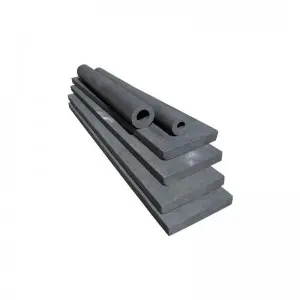
Furuite Graphite can evaluate graphite mold requirements together with materials such as graphite blocks and graphite plates based on the specific processing conditions. Factors including fixed carbon content, grain characteristics, density, and final application can be considered during material selection.
Providing these process conditions allows the graphite material to be evaluated more specifically. For new applications, sample testing can be carried out before moving to larger-scale production verification, reducing the risk of selecting a graphite material based on a single specification alone.
FAQ
What is the most important property of graphite mold material?
There is no single property that determines performance in every application. Thermal conductivity, density, purity, mechanical strength, grain structure, machinability, and dimensional stability may all become important depending on the process.
Why can a graphite mold change dimensions after repeated use?
Repeated heating and cooling, oxidation, mechanical stress, and gradual surface degradation can all cause dimensional changes. The extent of change depends on the graphite material and the actual processing conditions.
Is high-purity graphite always necessary for graphite molds?
No. High-purity graphite can be valuable for high-temperature, contamination-sensitive, or demanding processes, while density, thermal conductivity, machinability, or cost may be more important in other applications. The material should be selected according to the complete processing environment.
Post time: Sep-24-2026