In modern industrial manufacturing, precision, temperature resistance, and material stability are critical factors that directly affect production quality. Graphite moulds have become an essential tool in metal processing industries due to their ability to perform under extreme conditions while maintaining dimensional accuracy and structural stability. For manufacturers involved in casting, sintering, and advanced industrial processing, high quality graphite moulds provide a reliable and long-lasting solution.
Unlike conventional metal moulds, graphite moulds are engineered from high-purity graphite materials, giving them unique thermal, chemical, and mechanical advantages. These properties make them widely used in non-ferrous metal casting, powder metallurgy, high-temperature furnace applications, and precision component manufacturing.
Why Graphite Moulds Are Widely Used in Modern Industry
The increasing demand for high-performance materials has pushed manufacturers to adopt tools that can withstand extreme working environments. Graphite moulds are particularly valued because they maintain stability at high temperatures where many metals would deform or fail.
In industrial casting and forming processes, temperature consistency is crucial. If a mould expands unevenly or reacts with molten materials, the final product quality will be affected. Graphite moulds solve this problem by offering excellent thermal stability and low thermal expansion, ensuring consistent performance throughout repeated production cycles.
Another key reason for their popularity is their compatibility with a wide range of industrial materials. Whether used for aluminum, copper, gold, silver, or other non-ferrous metals, graphite moulds maintain stable performance without unwanted chemical reactions.
Key Advantages of High Quality Graphite Moulds
Graphite moulds are not just heat-resistant tools; they are engineered components designed for demanding industrial environments. Their advantages go beyond basic durability and include multiple performance benefits that directly impact production efficiency and product quality.
● Excellent high-temperature resistance
Graphite moulds can operate under extremely high temperatures without losing structural integrity. This makes them suitable for continuous casting, sintering furnaces, and other thermal processing systems where traditional moulds would fail.
● Low thermal expansion for dimensional accuracy
One of the most important features in precision manufacturing is stability under heat. Graphite expands minimally when exposed to high temperatures, helping maintain accurate mould dimensions and reducing defects in finished products.
● Strong chemical stability
During metal casting or sintering, moulds often come into contact with molten metals or reactive gases. Graphite has strong resistance to chemical reactions, which helps prevent contamination and ensures product purity.
● Excellent machinability for customized designs
Graphite materials are relatively easy to machine compared to many industrial metals. This allows manufacturers to produce complex mould shapes, fine details, and customized structures based on specific production requirements.
● Long service life in repeated production cycles
High quality graphite moulds can be used multiple times without significant degradation. This reduces replacement frequency and helps lower overall production costs in long-term industrial operations.
● Good thermal conductivity for controlled cooling
Graphite can efficiently transfer heat, which helps improve cooling efficiency during casting and sintering processes. This contributes to better microstructure formation and improved mechanical properties in final products.
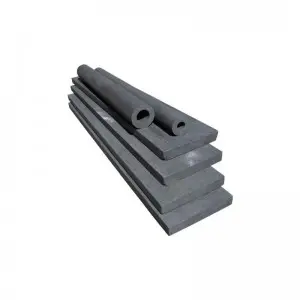
Graphite Moulds in Metal Casting Applications
Metal casting is one of the most common applications for graphite moulds, especially in non-ferrous metal industries. In this process, molten metal is poured into a mould cavity and cooled to form a solid structure.
Graphite moulds are particularly suitable for this process because they do not react easily with molten metals and can withstand repeated heating and cooling cycles. This stability is essential for maintaining consistent product quality in mass production environments.
In aluminum and copper casting, graphite moulds help ensure smooth surface finishes and accurate dimensional control. They also reduce the risk of sticking or adhesion between the mould and the molten material, which improves production efficiency and reduces waste.
For precious metal casting, such as gold or silver components, graphite moulds provide a clean and stable environment that helps preserve material purity and reduce contamination risks.
Graphite Moulds in Sintering Processes
Sintering is a manufacturing process where powdered materials are heated below their melting point until they bond together. This process is widely used in powder metallurgy, ceramics, and advanced material production.
Graphite moulds play a crucial role in sintering because they can maintain structural stability under high heat while providing a controlled shaping environment for powdered materials. During sintering, materials undergo complex physical changes, and the mould must remain stable to ensure consistent density and structural formation.
In powder metallurgy applications, graphite moulds are used to shape components before or during sintering. Their heat resistance and dimensional stability help ensure that the final product achieves the desired mechanical strength and density.
Additionally, graphite moulds reduce friction between the mould surface and powder materials, allowing easier release of finished parts after processing.
Industrial Processing and High-Temperature Manufacturing
Beyond casting and sintering, graphite moulds are widely used in various industrial processing systems that require high-temperature resistance and precise forming capabilities.
In furnace-based manufacturing environments, graphite moulds are used to shape materials during thermal treatment processes. This includes heat treatment of metals, carbon-based material processing, and specialized industrial forming operations.
Their ability to perform under continuous high heat makes them suitable for repeated use in production lines where stability and reliability are critical.
Graphite moulds are also used in advanced manufacturing sectors such as semiconductor-related materials, composite material shaping, and high-performance industrial component production.
Why Industries Prefer Graphite Mould Solutions
Industrial manufacturers prefer graphite moulds because they provide a combination of performance, efficiency, and cost-effectiveness. While initial machining and production may require technical precision, the long-term benefits often outweigh the costs.
Graphite moulds reduce downtime caused by mould failure, minimize maintenance requirements, and improve overall production stability. For industries operating under continuous production schedules, these advantages translate into significant operational value.
Another important factor is flexibility. Graphite moulds can be customized for different shapes, sizes, and applications, making them suitable for both small-scale precision manufacturing and large-scale industrial production systems.
Conclusion
High quality graphite moulds have become an essential component in modern metal casting, sintering, and industrial processing industries. Their unique combination of heat resistance, chemical stability, machinability, and dimensional accuracy makes them highly valuable in demanding production environments.
From non-ferrous metal casting to powder metallurgy and high-temperature industrial processing, graphite moulds provide reliable performance and long-term durability. As manufacturing industries continue to demand higher precision and efficiency, the role of graphite mould technology will continue to expand.
For B2B manufacturers and industrial buyers, investing in high quality graphite moulds is not only a technical decision but also a strategic choice that supports stable production, improved product quality, and reduced operational costs.
Post time: May-19-2026