Graphite Rod is used in industrial equipment when ordinary metal or ceramic components cannot provide the right balance of heat resistance, conductivity, low friction, and chemical stability. It is commonly found in furnaces, electrical systems, chemical equipment, casting processes, sealing structures, and custom-machined parts.
The value of a graphite rod does not come from its round shape alone. In many applications, the rod must continue working while exposed to repeated heating, electrical current, corrosive media, or sliding contact. Under these conditions, material selection directly affects service life, equipment stability, and maintenance frequency.
For buyers, the practical question is not whether graphite rod is “better” in general. The important point is whether its material behavior matches the real working environment.
High-Temperature Equipment Needs More Than Heat Resistance
When a component works inside a furnace or thermal processing system, it must do more than simply withstand a high temperature. It may also experience repeated heating and cooling, uneven temperature distribution, and long operating cycles.
Metal rods can expand, oxidize, soften, or lose dimensional accuracy under these conditions. Ceramic materials may provide heat resistance but can be difficult to machine or too fragile for certain structures.
A properly selected Graphite Rod can remain stable through repeated thermal cycles while still allowing precision machining. This makes it suitable for furnace supports, positioning parts, heating-related components, and other cylindrical elements used in thermal equipment.
For industrial users, this can mean:
- Fewer replacements caused by thermal deformation;
- More stable positioning inside the equipment;
- Easier customization for specific furnace structures;
- Better control during repeated heating cycles.
The correct result still depends on graphite grade, operating atmosphere, and component design.
Conductive Applications Require Stable Contact
Graphite Rod is also used in electrical and electrochemical systems because it can conduct electricity while remaining stable under heat and chemical exposure.
In these applications, the rod may serve as an electrode-related part, current-carrying component, conductive contact, or machined electrical element. The material must provide reliable contact rather than simply having basic conductivity.
A graphite rod used in an electrical system should be selected according to the actual current load, required resistance, operating temperature, and level of contamination control. A material that performs well as a furnace support may not automatically be suitable for a precision electrical application.
Important considerations include:
- Whether the rod must carry current continuously or intermittently;
- Whether the application requires high-purity graphite;
- Whether the contact surface needs precision machining;
- Whether heat is generated during operation;
- Whether the rod works in air, vacuum, or a controlled atmosphere.
Matching these conditions helps avoid unstable contact, premature wear, or inconsistent electrical performance.
Low-Friction Performance Without Additional Oil
Some industrial components operate in environments where oil or grease is difficult to use. High temperatures may cause lubricants to evaporate or burn, while dust and chemicals may contaminate conventional lubrication systems.
Graphite has a layered structure that helps reduce friction between contact surfaces. Because of this, Graphite Rod can be used in sliding, guiding, sealing, and bearing-related applications where dry or self-lubricating performance is useful.
This does not mean graphite rod can replace every metal shaft or bearing component. Graphite is more brittle than metal, so load, impact, and installation method must be considered carefully.
It is most useful when the application needs:
- Low friction under dry conditions;
- Stable operation at elevated temperatures;
- Reduced dependence on oil or grease;
- Resistance to certain corrosive environments;
- A custom cylindrical part with controlled dimensions.
In the right working conditions, graphite can help reduce maintenance and keep moving parts operating more smoothly.
Graphite Rod as a Machining Blank
Many buyers do not use graphite rod in its original form. Instead, they purchase it as a blank for further machining into custom parts.
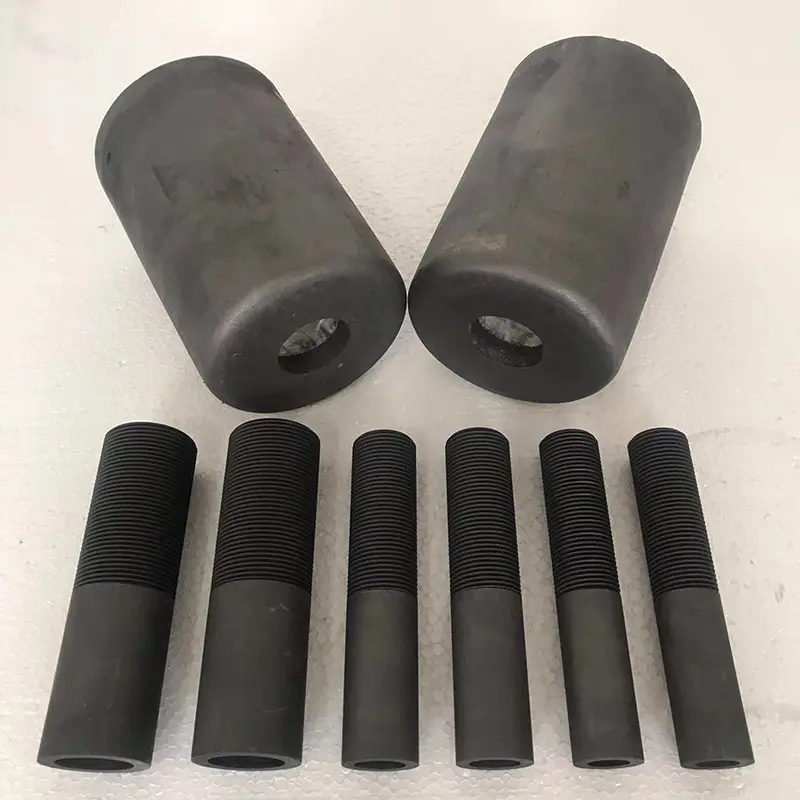
Graphite Rod can be processed by cutting, turning, drilling, grooving, threading, and polishing. This makes it useful for replacement parts, prototypes, small production runs, and equipment-specific components.
Typical custom machining includes:
- Cutting rods to the required length;
- Turning the outside diameter;
- Drilling center or side holes;
- Producing grooves, steps, or threads;
- Finishing contact surfaces;
- Machining parts directly from customer drawings.
However, the design should respect the material’s limitations. Thin walls, sharp internal corners, very deep narrow grooves, and unsupported long sections can increase the risk of chipping or cracking.
A small change in design, such as adding a radius or increasing wall thickness, may significantly improve the durability of the finished graphite part.
Material Grade Changes the Final Result
Two graphite rods with the same diameter and length can perform very differently. The difference often comes from grain size, density, purity, strength, and internal consistency.
Fine-grain graphite is generally more suitable for parts that require precise details and smoother surfaces. Higher-purity grades may be needed in electrical, laboratory, semiconductor, or other contamination-sensitive applications. For furnace use, thermal stability and oxidation behavior may be more important.
Instead of comparing only dimensions and price, buyers should look at how the material will behave in service.
A suitable Graphite Rod should match:
- Working temperature;
- Mechanical load;
- Electrical requirements;
- Chemical exposure;
- Machining precision;
- Expected service cycle.
This helps prevent problems that may not appear immediately but develop after repeated use, such as surface wear, oxidation, cracking, or loss of dimensional accuracy.
Handling Can Affect Performance Before Installation
Graphite rod can work reliably in demanding environments, but it is still more brittle than metal. Damage may occur during transport, storage, clamping, or installation if the rod is handled roughly.
Long rods need proper support to prevent bending stress. Ends and edges should be protected from impact, and clamping pressure should be controlled during machining. Even a small crack can become a weak point later, especially under heat or repeated loading.
Before installation or machining, the rod should be checked for:
- Chipped ends or damaged edges;
- Visible surface cracks;
- Contamination or moisture;
- Bending or uneven support marks;
- Damage caused by packaging or transport.
Careful handling protects both machining accuracy and service life.
FAQ
1. What is Graphite Rod mainly used for?
Graphite Rod is used in furnace components, conductive parts, chemical equipment, sealing structures, casting tools, sliding components, and custom-machined industrial parts.
2. Can Graphite Rod replace a metal rod?
It can replace metal in selected applications where heat resistance, conductivity, corrosion resistance, or low-friction performance is more important than impact strength. The decision should be based on actual load and working conditions.
3. Can Graphite Rod be machined into custom parts?
Yes. It can be cut, turned, drilled, grooved, threaded, polished, and machined according to drawings. The design should avoid overly thin walls and sharp corners that may cause chipping.
4. What should buyers check before ordering Graphite Rod?
Buyers should confirm the working temperature, application environment, required dimensions, graphite grade, electrical needs, machining requirements, surface finish, and expected service life.
Post time: Jul-24-2026