A Graphite Recarburizer is used to raise and control carbon content in molten iron or steel, but a high fixed-carbon value does not automatically mean high carbon recovery. Two Graphite Recarburizer products may both show 98% fixed carbon on their specification sheets while producing very different results in the furnace. One may dissolve quickly and reach the target carbon level with a relatively small addition, while another may remain on the melt surface, increase slag residue, require longer holding time, or raise material consumption per ton of metal.
The reason is that fixed carbon describes how much carbon is present in the material, while carbon recovery shows how much of that carbon actually enters the molten metal. For foundry and steelmaking operations, this difference directly affects carbon adjustment, melting time, material consumption, slag conditions, and actual production cost. Therefore, a Graphite Recarburizer should be evaluated by its furnace performance rather than by fixed carbon alone.
Fixed Carbon Is Only the Starting Point
If 10 kg of a Graphite Recarburizer containing 98% fixed carbon is added to a furnace, the material theoretically contains about 9.8 kg of carbon. In practice, however, the molten metal may absorb only part of that amount. Some carbon can oxidize before entering the bath, some may remain trapped in slag, and some particles may leave the furnace without fully dissolving.
A simple way to understand this difference is:Effective carbon input = Recarburizer addition × Fixed carbon × Carbon recovery
This explains why two materials with the same fixed-carbon value can require different addition rates. A Graphite Recarburizer with slightly higher unit cost may still reduce the final cost per ton of metal when its carbon recovery is more stable and less material is required to reach the target composition.
The actual recovery is influenced by several conditions:
- Melt temperature;
- Particle size;
- Addition timing;
- Bath circulation and stirring;
- Slag thickness;
- Contact time before tapping.
These factors should be reviewed together instead of treating fixed carbon as the only measure of quality.
Why Does Graphite Recarburizer Remain on the Melt Surface?
When Graphite Recarburizer remains visible on the surface of molten metal, the first reaction is often to blame the material. In many cases, however, the problem is related to the way graphite contacts the melt. The same recarburizer can perform differently when the furnace charging sequence changes.
If the material is added together with solid furnace charge, it may become surrounded by molten metal as the charge melts, giving the graphite more time and surface contact to dissolve. If the same product is added late, after the bath has already melted and a thick slag layer has formed, much of the graphite may remain above the metal instead of entering it.
When absorption becomes slow, the most useful checks are:
- Was the Graphite Recarburizer added early enough?
- Did the material enter below the slag layer?
- Was the melt hot enough at the time of addition?
- Was there enough circulation to move graphite through the bath?
- Was sufficient time available before tapping?
Improving these conditions can sometimes increase carbon recovery without changing the recarburizer grade.
Particle Size Controls Both Reaction Speed and Material Loss
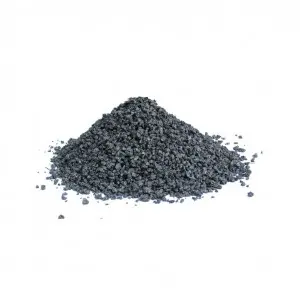
Particle size is another reason why two Graphite Recarburizer products with similar chemical specifications may behave differently. Fine particles provide more surface area, allowing carbon to contact molten metal more quickly. However, excessive fines may increase dust, handling loss, oxidation, and material floating on the bath surface.
Coarser particles are easier to handle and create less dust, but they require more time to dissolve. If the furnace cycle is short, oversized particles may still remain in slag or on the melt when tapping begins.
The practical balance is therefore:
- Fine particles: faster reaction, but higher risk of dust and oxidation loss;
- Medium particles: often easier to balance between dissolution and handling;
- Coarse particles: lower dust, but longer dissolution time.
The correct particle size depends on the actual furnace cycle, not on the assumption that finer or coarser material is always better.
A Lower Purchase Price Can Lead to a Higher Melting Cost
The price per ton of Graphite Recarburizer is easy to compare, but it does not show how much the material actually costs during production. A lower-priced product may require a higher addition rate, create more slag, or need repeated carbon correction before the melt reaches the required chemistry.
For example, one material may cost less but require 12 kg per ton of molten metal, while another costs slightly more but requires only 10 kg to achieve the same carbon increase. In this situation, the higher-priced material may have the lower real operating cost.
A more useful comparison is:
Graphite Recarburizer cost required to achieve the target carbon increase per ton of molten metal.
This approach reflects actual carbon recovery and makes it easier to compare materials under real production conditions.
Furnace Behavior Can Reveal the Real Problem
Instead of replacing the recarburizer whenever carbon results change, production behavior can help identify where the problem begins.
| Production Problem | What to Check First |
|---|---|
| Graphite remains on the melt surface | Addition timing, slag, stirring, particle size |
| Carbon level rises slowly | Melt temperature, contact time, particle size |
| Recarburizer consumption increases | Carbon recovery, furnace operation, scrap mix |
| Carbon remains in slag | Poor melt contact, early slag formation, coarse particles |
| Heavy dust appears during charging | Excessive fines or unsuitable feeding method |
| Carbon results vary between heats | Dosing accuracy, segregation, operating consistency |
This type of troubleshooting helps separate Graphite Recarburizer quality issues from furnace-operation problems and prevents unnecessary material changes.
Sulfur and Ash Matter Because They Reduce the Useful Carbon Value
Low sulfur is important in many iron and steel processes, particularly when the final sulfur level needs strict control. However, sulfur should be considered as part of the complete furnace chemistry rather than treated as an isolated number. What matters is how much sulfur the Graphite Recarburizer adds to the melt and whether that contribution affects the target composition.
Ash also deserves attention because it does not provide useful carbon. A higher ash level means a larger portion of the added material does not contribute to carbon adjustment and may instead increase the amount of non-carbon material entering the slag.
For practical comparison, several values should be considered together:
- Fixed carbon;
- Sulfur;
- Ash;
- Particle size;
- Carbon recovery in actual furnace operation.
A material with very high fixed carbon but unstable recovery may perform worse than a grade with slightly different chemical specifications but more consistent absorption.
Repeatable Carbon Recovery Is More Valuable Than One Good Furnace Test
A single successful melting test is not enough to judge Graphite Recarburizer performance. A more useful evaluation comes from repeated furnace records under similar operating conditions. When the same material consistently produces a predictable carbon increase, stable slag behavior, and limited unabsorbed residue, both metallurgical control and operating cost become easier to manage.
Useful production records include:
- Graphite Recarburizer consumption per ton of metal;
- Carbon increase after addition;
- Amount of visible unabsorbed graphite;
- Melting and holding time;
- Slag condition;
- Variation between different heats.
For foundry and steelmaking applications, the real value of a Graphite Recarburizer is not simply how much carbon it contains, but how efficiently and consistently that carbon becomes part of the molten metal.
FAQ
1. Why can two Graphite Recarburizer products with 98% fixed carbon perform differently?
Because fixed carbon describes composition rather than actual absorption. Particle size, melt temperature, addition timing, stirring, slag condition, ash, and contact time can all change carbon recovery.
2. Why does Graphite Recarburizer float on molten metal?
Common causes include insufficient contact with the melt, heavy slag coverage, low melt temperature, weak stirring, unsuitable particle size, or adding the material too late in the melting cycle.
3. Is finer Graphite Recarburizer always better?
No. Fine material may react faster but can create more dust and oxidation loss. Coarse material is easier to handle but requires more dissolution time. The most suitable particle size depends on the furnace process.
4. How should Graphite Recarburizer cost be compared?
Compare the actual amount and total cost required to achieve the target carbon increase per ton of molten metal rather than comparing only the purchase price per ton.
Post time: Aug-19-2026