Super Fine Graphite Powder is often chosen when a formulation requires finer graphite distribution, a smoother surface, or closer contact between graphite and surrounding materials. However, replacing conventional graphite powder with a much finer grade is not simply a change in particle-size specification. Even when the graphite type and fixed carbon remain similar, smaller particles can change powder flow, wetting behavior, viscosity, mixing efficiency, compaction, and storage stability.
For this reason, Super Fine Graphite Powder should be evaluated as part of the complete production process. A formulation that performs well with conventional graphite may need different feeding, mixing, binder, or handling conditions after the particle size becomes much finer. The real advantage of superfine graphite appears when the finer particles improve the finished product without creating unnecessary difficulties in production.
Super Fine Graphite Powder Can Improve Distribution Before It Improves Performance
One of the most direct advantages of superfine graphite is its ability to distribute more evenly through fine coatings, slurries, composite materials, and powder formulations. Smaller particles can enter spaces between larger raw materials and create more contact points throughout the system.
This can be useful when a product requires a smooth surface, uniform carbon distribution, or a relatively thin functional layer. In coatings, for example, coarse graphite particles may remain visible on the surface, while finer material can help produce a more consistent appearance when dispersion is properly controlled.
However, particle size alone does not determine the final result. A very fine graphite powder that forms agglomerates during storage or mixing may behave like much larger particles in the finished formulation. This means that primary particle size and actual dispersion are not the same thing.
Instead of judging superfine graphite only by mesh size or average particle diameter, it is more useful to examine the final coating, slurry, pressed part, or composite structure.
Finer Graphite Can Change Wet Mixing More Than Expected
When Super Fine Graphite Powder enters a liquid system, its larger total surface area creates more contact with resin, solvent, oil, water-based carrier, or other liquid components. This often improves the potential for fine distribution, but it can also increase the amount of liquid required to wet the graphite surface.
As a result, a formulation that previously flowed easily may become noticeably thicker after switching to a finer graphite grade. This is particularly relevant in coatings, slurries, lubricating formulations, and other systems where viscosity directly affects processing.
If viscosity rises unexpectedly, increasing solvent or reducing graphite content is not always the first solution. The problem may come from how the powder is introduced into the mixture. Addition speed, mixing sequence, shear level, and wetting time can all change the result.
A controlled trial can therefore help determine whether the formulation really needs to change or whether the existing mixing process simply needs to be adjusted for the finer powder.
Powder Handling May Become the First Production Challenge
The benefits of Super Fine Graphite Powder are often discussed in terms of the final product, but the first noticeable difference may appear at the feeding stage.
Very fine powders usually have stronger particle-to-particle interaction than coarser materials. They may retain more air, form soft agglomerates, stick to equipment surfaces, or flow less consistently through small openings. Manual feeding can also generate more airborne dust if the handling method is not suitable.
These differences matter on production lines that rely on automatic dosing or continuous feeding. A powder that performs well in a laboratory container may behave differently when transferred through a hopper, screw feeder, or larger mixing system.
The important point is that poor flow does not necessarily indicate poor graphite quality. It may simply mean that the feeding equipment was originally designed around a coarser powder.
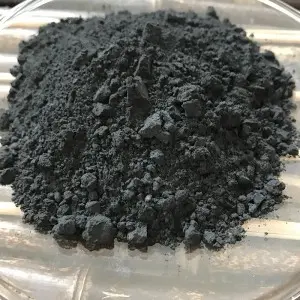
Super Fine Graphite Powder Behaves Differently in Dry Blends
In dry formulations, superfine graphite can fill spaces between larger particles and help improve material distribution. This can be useful in carbon products, refractory mixtures, friction materials, and other powder-based systems.
However, dry blending creates another issue: the mixture must remain uniform after leaving the mixer.
A blend may look well distributed immediately after mixing but later pass through storage hoppers, screw conveyors, packaging equipment, vibration, and transportation. Differences in particle size and density can cause redistribution during these stages.
For this reason, dry-mix performance should not be judged only at the end of the laboratory mixing cycle. It is more meaningful to check whether graphite distribution remains stable after the material has experienced the same handling conditions used in production.
Pressing and Forming Can Change Even When the Formula Stays the Same
Super Fine Graphite Powder can also influence the packing structure of pressed or molded powder products. Fine graphite particles may fill voids between larger raw-material particles, changing mold filling and green density even if the total formulation remains unchanged.
At the same time, finer graphite provides more surface area for binders to cover. This can alter binder distribution and influence compaction behavior. In some systems, the powder may require different pressing conditions or binder adjustments to maintain a consistent formed structure.
If density, surface condition, or forming behavior changes after switching graphite grades, it is therefore useful to check particle packing before assuming that the chemical composition is responsible.
Where Super Fine Graphite Powder Adds the Most Value
The value of superfine graphite becomes clearer when the application genuinely benefits from finer distribution rather than simply demanding the smallest possible particle size.
| Application | Potential Benefit | What Should Be Checked |
|---|---|---|
| Coatings and slurries | Smoother surface and finer distribution | Dispersion and viscosity |
| Composite materials | More uniform graphite contact | Binder compatibility |
| Dry powder formulations | Better filling between larger particles | Segregation after handling |
| Pressed products | Finer packing structure | Density and binder distribution |
| Precision formulations | Reduced visible coarse particles | Agglomeration control |
This is why Super Fine Graphite Powder should be selected around the finished product and production method rather than by particle size alone.
Matching Super Fine Graphite Powder to the Actual Process
When a project requires finer graphite, useful information includes not only the target particle size but also the application medium, mixing method, desired surface condition, forming process, and final performance requirement.
For coatings and liquid systems, viscosity and dispersion may be the first priorities. For dry blends, flow and segregation may matter more. In pressed products, packing density and binder interaction become more important.
Furuite offers Super Fine Graphite Powder as part of its graphite powder product range. For applications involving coatings, slurries, powder mixtures, or formed carbon materials, communicating the intended particle size, fixed carbon requirement, processing method, and final use can make grade matching more efficient than selecting a product based only on mesh size.
For projects moving from a conventional graphite powder to a finer grade, trial samples and production-scale verification can also help identify whether feeding, mixing, or binder conditions need adjustment before full-scale use.
Superfine Does Not Mean Universally Better
The main advantage of Super Fine Graphite Powder is its ability to provide finer distribution and more intimate contact within a formulation. At the same time, that smaller particle size can increase viscosity, dust, agglomeration, and handling sensitivity.
The right grade is therefore not necessarily the finest graphite available. It is the particle size that improves the final product while remaining compatible with the existing production process.
For industrial applications, the most useful result is achieved when particle size, dispersion, processing conditions, and finished-product requirements are considered together.
FAQ
1. What is Super Fine Graphite Powder commonly used for?
It is used in coatings, slurries, composites, powder mixtures, formed carbon products, and other applications requiring fine graphite distribution or smoother surfaces.
2. Why can Super Fine Graphite Powder increase viscosity?
Smaller graphite particles provide more total surface area for the liquid or binder to wet, so the same graphite loading can produce a thicker formulation.
3. Is finer graphite always better for dispersion?
Not necessarily. Fine particles can distribute more uniformly, but they are also more likely to agglomerate. Mixing and wetting conditions remain important.
4. What information helps when selecting Super Fine Graphite Powder?
Useful information includes particle-size requirement, fixed carbon, application medium, mixing or forming method, desired surface condition, and final product requirements.
Post time: Sep-08-2026