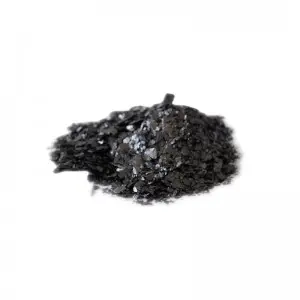
Graphite Granules are used in industrial formulations that require controlled carbon content, stable feeding, heat resistance, lubrication, or electrical performance. They may be added to foundry materials, refractory mixtures, friction products, conductive compounds, lubricating formulations, and other carbon-based systems.
Although graphite granules may appear to be a simple raw material, their size distribution has a direct effect on storage, feeding, mixing, reaction speed, and final product consistency. Material that is too fine may create dust or flow unevenly, while oversized particles may disperse slowly or remain visible in the finished mixture.
For this reason, selecting graphite granules should begin with the production process rather than only the carbon content.
Fine Particles Can Improve Dispersion but Increase Dust
Smaller graphite particles provide a larger contact area. This can help graphite distribute more evenly through coatings, refractory mixtures, lubricating materials, and other formulations.
However, very fine graphite is more difficult to handle. It can become airborne during unloading, transfer, weighing, and mixing. Dust loss changes the actual amount entering the formulation and can also contaminate nearby equipment.
Excessively fine material may cause:
- Unstable feeding from hoppers;
- Dust accumulation around mixers;
- Material loss during pneumatic transfer;
- Poor weighing accuracy;
- Agglomeration when moisture is present;
- Increased requirements for ventilation and filtration.
Fine graphite is useful when dispersion is important, but the production line must be able to control dust and maintain accurate dosing.
Coarse Granules Behave Differently During Mixing
Larger Graphite Granules are generally easier to handle and produce less airborne dust. They can flow more consistently through some feeding systems and may be suitable for processes where graphite is expected to remain as a visible or functional particle.
The disadvantage is that coarse particles require more mixing energy and time to distribute evenly. In some formulations, they may separate from lighter powders during transport or vibration.
If the particle size is too large, the process may experience:
- Uneven carbon distribution;
- Slow reaction or dissolution;
- Rougher finished surfaces;
- Sedimentation in liquid mixtures;
- Segregation during storage;
- Blockage in narrow feeding equipment.
The suitable size therefore depends on whether the graphite must dissolve, react, remain suspended, or simply become evenly distributed.
A Narrow Size Range Improves Process Repeatability
A batch described only as “graphite granules” may still contain a wide range of particle sizes. Large differences between fine and coarse fractions can make feeding and mixing unpredictable.
Fine particles may remain near the top of a container, while heavier granules settle during transport. By the time the material reaches production, the first portion removed from the package may have a different size distribution from the final portion.
A controlled particle-size range helps improve:
- Consistency between production batches;
- Stable flow through automatic feeders;
- Uniform mixing time;
- More accurate carbon addition;
- Predictable surface and mechanical results.
For repeated production, size distribution can be just as important as average particle size.
Moisture Changes Flow and Mixing Behavior
Graphite itself does not dissolve in water, but moisture can still affect how Graphite Granules behave. Damp material may form lumps, stick to hopper walls, or flow irregularly through dosing systems.
Moisture can also make fine graphite adhere to larger granules, temporarily changing the apparent particle-size distribution. Once the material dries during processing, these clusters may break apart and create unexpected dust.
Storage should therefore prevent:
- Direct contact with rain;
- Placement on damp floors;
- Long exposure to humid air;
- Condensation inside packaging;
- Mixing with wet process materials before controlled dosing.
Dry, sealed storage helps maintain stable flow and weighing accuracy.
Graphite Granules in Foundry and Metallurgical Processes
In foundry and metallurgical production, graphite granules may be used as a carbon-containing material or as part of a formulation. Their effectiveness depends on how quickly they contact the molten metal or combine with other materials.
Smaller granules generally react faster because they expose more surface area. However, very fine graphite may float, oxidize, or become trapped in slag before entering the melt.
Coarser material may reduce dust loss but require longer contact time. The ideal balance depends on:
- Furnace type;
- Charging sequence;
- Melt temperature;
- Stirring conditions;
- Holding time;
- Target carbon level.
Changes in graphite size should therefore be tested together with the actual furnace process rather than evaluated separately.
Refractory and Coating Formulations Need Uniform Mixing
Graphite is added to selected refractory products and industrial coatings to support heat resistance, lubrication, carbon content, and surface behavior.
In these formulations, particle size affects how the graphite fits between other raw materials. Fine graphite may fill small spaces and create a smoother mixture, while larger granules can change texture, porosity, and flow.
A mixture containing several mineral powders usually requires graphite with a compatible size range. If the graphite is much coarser or lighter than the other ingredients, segregation may occur during transport or vibration.
The mixing sequence also matters. Adding graphite too quickly can create floating layers or local concentrations, while gradual feeding often produces better distribution.
Feeding Equipment Must Match the Material
Graphite granules may be added manually or through screw feeders, vibrating trays, weighing systems, or pneumatic transport equipment. Each method handles particle size differently.
Fine graphite may bridge inside a hopper or leak through equipment gaps. Large granules may block small outlets or produce irregular flow.
Before setting a material specification, the feeding system should be checked for:
- Hopper angle and outlet size;
- Screw or conveyor clearance;
- Required dosing accuracy;
- Transfer distance;
- Dust-collection capacity;
- Risk of material segregation.
A well-matched feeding system reduces production interruptions and helps maintain accurate graphite content.
FAQ
1. What are Graphite Granules used for?
Graphite Granules are used in foundry materials, metallurgical processes, refractory formulations, industrial coatings, lubricating products, conductive mixtures, and other carbon-based applications.
2. Are fine Graphite Granules always better?
No. Fine particles disperse faster but may create more dust and flow problems. The correct size depends on mixing, feeding, reaction speed, and the required finished result.
3. Why do Graphite Granules separate during transport?
Separation may occur when the material contains a wide particle-size range. Vibration causes larger and heavier particles to move differently from fine particles, producing uneven distribution.
4. What should be confirmed before selecting Graphite Granules?
The application should confirm particle size, carbon content, ash, moisture, feeding method, mixing process, packaging, and required production consistency.
Post time: Aug-04-2026