Maintaining the correct carbon level is an important part of foundry and metallurgical production. If the carbon content is too low, the final metal may not achieve the expected structure or processing performance. If carbon addition is poorly controlled, the melting cycle may become longer, material loss may increase, and product quality may vary between batches.
Amorphous Graphite is widely used in foundries, steelmaking, refractory materials, coatings, and carbon-based formulations. Compared with graphite products designed for precision machining or electrical applications, amorphous graphite is often selected for processes that require practical carbon addition, heat resistance, and stable industrial performance.
Its value depends not only on carbon content. Particle size, ash level, moisture, feeding method, furnace temperature, and contact time all affect how the material behaves during production.
Carbon Addition Is Not Simply About Adding More Graphite
In melting operations, carbon must enter the molten metal efficiently and consistently. Adding a larger amount of graphite does not automatically produce a better result. If the material floats on the melt, reacts too slowly, or contains excessive impurities, the foundry may need more time and energy to reach the target carbon level.
Amorphous Graphite can support carbon adjustment when its grade and particle size match the furnace process. The material is commonly used where production requires an economical and stable source of carbon rather than an extremely high-purity specialty graphite.
A successful carbon addition process should help achieve:
- More consistent carbon levels between melting batches;
- Reduced need for repeated composition adjustment;
- Better control of melting time;
- Lower risk of unused carbon remaining in slag;
- More predictable final metal performance.
The actual result depends on how the graphite is introduced into the furnace and how well it contacts the molten metal.
Particle Size Changes the Melting Response
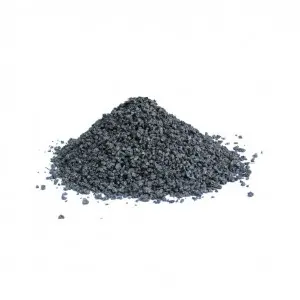
Particle size has a direct effect on how Amorphous Graphite moves, reacts, and dissolves during melting. Very fine material offers a large contact area, but it may create dust, float on the melt, or be lost during handling. Coarser material is easier to feed, although it may require more time to react completely.
There is no single particle size suitable for every foundry. The correct range depends on furnace type, charging sequence, operating temperature, and the metal being processed.
For example, graphite added together with solid furnace charge behaves differently from graphite added directly onto molten metal. A material that works well in an induction furnace may not produce the same result in another melting system.
Before selecting a grade, the foundry should consider:
- How the graphite enters the furnace;
- Whether it is mixed with scrap or added later;
- The available melting and holding time;
- Dust-control requirements;
- The acceptable level of undissolved material.
Matching particle size with the feeding method can improve carbon recovery and reduce unnecessary material loss.
Stable Moisture Supports More Predictable Feeding
Moisture is sometimes overlooked because Amorphous Graphite appears dry from the outside. However, inconsistent moisture can affect storage, weighing, feeding accuracy, and furnace behavior.
Wet or poorly stored material may form lumps, flow unevenly, or create safety concerns when introduced into high-temperature equipment. It can also make the actual carbon amount less predictable because part of the measured weight comes from water rather than graphite.
Good storage practices include keeping the material:
- In sealed and dry packaging;
- Away from rain and humid floors;
- Protected from contamination by metal scrap or chemicals;
- Clearly separated by grade and particle size.
Consistent storage conditions help maintain the same feeding behavior from one batch to the next.
Foundry Performance Depends on the Complete Process
When carbon recovery is lower than expected, the graphite material is not always the only cause. Furnace temperature, slag condition, addition timing, stirring, and holding time can all influence the result.
For example, graphite added too late may not have enough time to dissolve. Material placed on a thick slag layer may not contact the molten metal effectively. Low bath temperature can slow the reaction, while excessive exposure to air may increase oxidation loss.
Before changing graphite grades, foundries should review the complete process:
- Confirm the target carbon level and current metal composition.
- Check where and when the graphite is added.
- Review furnace temperature and mixing conditions.
- Measure actual carbon recovery over several batches.
- Compare material consumption with the final metallurgical result.
This approach makes it easier to separate material-quality issues from operating problems.
Beyond Carbon Addition
Although foundry carbon adjustment is an important use, Amorphous Graphite also appears in other industrial materials. Its heat resistance, carbon content, and lubricating behavior make it useful in selected refractory products, casting coatings, brake materials, lubricating formulations, and certain construction-related mixtures.
In these applications, the required grade may be completely different. A graphite used in a casting coating may need controlled fineness and dispersion, while a refractory formulation may focus more on carbon level, heat behavior, and compatibility with other raw materials.
This is why application details should be provided before ordering. Using one general graphite grade for every process may lead to inconsistent results.
Selecting Amorphous Graphite for Production
A practical selection process should begin with the production target rather than a product name. Buyers should confirm the required carbon contribution, acceptable impurity level, feeding method, particle range, and expected monthly consumption.
The most useful information to provide includes:
- Application and furnace type;
- Metal or alloy being processed;
- Required fixed carbon level;
- Preferred particle-size range;
- Maximum acceptable ash and moisture;
- Packaging and feeding requirements;
- Current problems such as dust, slow dissolution, or low carbon recovery.
Clear information allows the material to be matched with the process and reduces the need for repeated production adjustments.
FAQ
1. What is Amorphous Graphite mainly used for?
Amorphous Graphite is commonly used in foundry carbon addition, metallurgical processing, refractory materials, casting coatings, lubricating formulations, and other industrial products that require carbon and heat-resistant performance.
2. Is Amorphous Graphite suitable for all metal melting processes?
Not automatically. Its suitability depends on the metal, furnace type, required carbon level, particle size, ash content, and feeding method. Trial testing is recommended when changing grades or processes.
3. Why does some graphite fail to dissolve completely?
Incomplete dissolution may be caused by unsuitable particle size, low melt temperature, insufficient contact time, poor mixing, late addition, or graphite remaining on the slag instead of contacting the molten metal.
Post time: Jul-28-2026