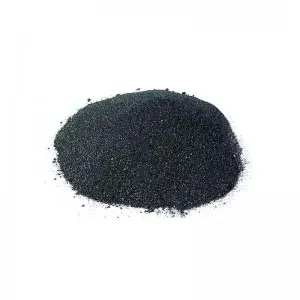
Black graphite powder is used in industrial formulations such as lubricating materials, conductive compounds, coatings, and friction products. In these applications, consistent distribution is essential because uneven mixing can create differences in composition and affect the performance of the finished material. Agglomeration occurs when individual particles gather into clusters instead of dispersing evenly. These clusters may develop during storage, feeding, or mixing, and simply extending the mixing cycle does not always solve the problem. Understanding the causes helps production teams improve dispersion while avoiding unnecessary changes to the formulation.
Why Black Graphite Powder Forms Clusters
The tendency of black graphite powder to form clusters depends on several interacting properties, including particle size, shape, surface condition, and moisture. Fine particles may interact strongly with one another, while flaky graphite can overlap or gather into layered groups under certain handling conditions. These characteristics influence how easily the powder separates during mixing.
The surrounding ingredients also affect dispersion. In a dry blend, differences in particle size and flow behavior may cause graphite to collect in specific areas. In liquid formulations, insufficient wetting can leave dry material inside a cluster, even when its outer surface has already contacted the liquid. These internal dry pockets can make the agglomerate difficult to break apart.
Handling conditions may contribute to the problem before the powder reaches the mixer. Unsuitable storage can expose the material to moisture, while prolonged pressure inside a container may compact the powder. Irregular feeding can also introduce too much graphite into one area at once, creating concentrated deposits that are harder to disperse. Identifying the source of agglomeration is therefore more useful than immediately increasing mixing speed. A problem caused by poor wetting requires a different response from one caused by inconsistent feeding or compacted material.
How Mixing Sequence Affects Dispersion
The order in which ingredients enter the mixer influences how black graphite powder spreads through a formulation. If a large quantity is added too quickly, the powder may accumulate before the equipment can distribute it. Other ingredients can then surround these deposits, making them more difficult to separate during later mixing.
Gradual addition often gives graphite more opportunities to contact the surrounding material. In dry blends, controlled feeding can reduce localized concentrations. In liquid systems, the powder needs sufficient contact with the liquid phase to become properly wetted. Depending on the formulation, introducing graphite gradually into a moving liquid or preparing a suitable premix may improve dispersion.
The best sequence depends on the equipment, batch size, and characteristics of the other ingredients. A method that works well for one formulation may not be suitable for another, so changes should be tested under actual production conditions.
Mixing time should also be distinguished from effective mixing. If powder remains trapped in poorly wetted clusters or areas where material movement is limited, running the equipment longer may provide little improvement. Adjusting the addition sequence or improving circulation can sometimes produce better results without extending the production cycle.
Practical Ways to Reduce Agglomeration
Reducing clusters requires attention to material handling and mixing conditions. The following measures provide a practical starting point for process evaluation:
- Improve storage and handling. Keep containers properly closed and follow suitable storage conditions to reduce moisture exposure and contamination. Inspect the powder before use for compacted areas or unusual changes. Where appropriate, break up soft lumps using a method compatible with the material and application.
- Control the feeding rate. Add graphite at a rate that allows the mixer to distribute the powder before more material accumulates in the same location. Avoid dumping the entire quantity into one area unless this approach has been validated for the process.
- Review ingredient order. Test whether adding graphite earlier, later, or in stages improves distribution. For liquid formulations, check whether the powder is being wetted adequately rather than simply circulating on the surface.
- Match mixing action to the formulation. Consider the equipment’s ability to move material throughout the batch. Higher rotational speed alone does not guarantee uniform dispersion; fill level, viscosity, equipment geometry, and material circulation also matter.
- Check samples from different locations. Compare representative samples from different parts of the batch when practical. Visual inspection can identify obvious clusters, while relevant application tests can help reveal differences that are not visible to the naked eye.
These measures are most useful when evaluated systematically. Changing several operating conditions simultaneously makes it difficult to determine which adjustment improved dispersion. Testing one variable at a time provides clearer information and helps establish a repeatable process.
Why Longer Mixing Does Not Always Help
Extending the mixing cycle is a common response to visible clusters. It may help when the agglomerates are weak and the equipment provides enough movement to separate them. However, extra mixing time is unlikely to resolve poor wetting, unsuitable ingredient order, or inadequate circulation on its own.
Excessive mechanical action may also introduce unwanted effects. Depending on the formulation, it can increase heat or affect the physical condition of other ingredients. The appropriate mixing intensity therefore depends on the complete material system and its intended application, rather than on graphite alone.
A more reliable approach is to establish an endpoint based on the required level of uniformity. Visual checks can reveal large lumps, but they may not identify small differences in composition. When dispersion affects electrical, frictional, coating, or lubrication performance, suitable application-related tests should support the inspection process.
Production records can help identify recurring problems. Recording material batches, storage conditions, feeding sequences, mixing settings, and observed results makes it easier to distinguish a process issue from a change in raw material behavior. Over time, these records can support more consistent operating procedures.
Selecting Black Graphite Powder for the Intended Application
Mixing adjustments cannot compensate for every mismatch between a material and its intended use. When selecting black graphite powder, consider its physical characteristics alongside the formulation and production method. Particle-size distribution, moisture condition, purity requirements, and physical form may all influence handling and dispersion.
Different applications have different requirements. A dry blend needs appropriate powder flow and distribution, while a liquid coating requires effective wetting. Conductive compounds may depend on consistent distribution of functional ingredients, whereas friction materials need graphite to be dispersed appropriately throughout the composition. Material suitability should therefore be evaluated against the finished product’s performance requirements.
Before changing raw materials, determine whether the issue originates in the powder, the mixing process, or interactions between ingredients. Controlled trials using consistent conditions can help identify the cause and show whether a change in material characteristics produces a meaningful improvement.
Qingdao Furuite Graphite Co., Ltd. offers graphite products, including flake graphite and graphite powder, for different industrial applications. When evaluating black graphite powder for a particular formulation, clarifying the intended use, material requirements, and processing conditions helps establish a more suitable basis for product selection and testing.
Conclusion
Preventing agglomeration requires more than increasing mixing intensity. Storage, feeding, ingredient sequence, wetting, and equipment performance all influence how black graphite powder disperses. By identifying where clusters develop, adjusting process conditions systematically, and checking representative samples, production teams can improve consistency without making unnecessary changes to the formulation.
FAQs
1. Can graphite powder agglomerate even under suitable storage conditions?
Yes. Clusters can form during feeding or mixing because of particle interactions, insufficient wetting, or differences between graphite and other ingredients.
2. Does finer graphite powder always disperse less easily?
No. Particle size is only one consideration. Shape, surface condition, formulation, and mixing method also influence dispersion behavior.
3. Is visual inspection enough to confirm uniform mixing?
Visual inspection can identify obvious clusters, but it may not reveal smaller differences. Applications that depend on consistent material performance may require additional testing.
4. Is a dispersing agent always necessary?
No. A dispersing agent may help in certain formulations, particularly liquid systems, but its compatibility must be assessed. Adjusting the feeding sequence or mixing conditions may be sufficient in other cases.
Post time: Oct-29-2026